After a muted post-election season dominated by the National Resistance Movement’s lukewarm effort to articulate a fresh vision, amidst a growing exit of its traditional opponents, the headlines are today filled to the brim with the concert tour of Hon Balaam Barugahara Ateenyi MP, the Minister of Local Government.
The election in January that returned President Museveni for a seventh term with 71.65 per cent of the vote, according to the Electoral Commission, seems almost ten years ago. It stands that such a major statistical victory should have gotten the party that claimed it in a confident mood. But observers note it has mostly been one form of anxiety after another.
This tension may be down to many things, but the pundits put most of the inertia on “succession” issues. Some of it is refracted from the just concluded ballot, like the rejection of the result by Robert Kyagulani (the NUP leader now in the United States as a refugee), and the dramatic rendition and jailing of opposition leading man Dr. Kizza Besigye who remains in prison and critically ill. His collapse in court before the TV cameras was a real shock image but definitive of the moment. Much of the older opposition is either fragmented, diminished or outside the immediate contest for power.
Many are choosing exile.
In these conditions it is not surprising that the post-election political argument has shifted from who governs Uganda to how the NRM governs. Or what to expect in the next couple of years. It is that state of national purgatory within which folks are looking backwards and forwards depending on their faith in the establishment and their own experience of its long stay at the helm of Ugandan public affairs. Hon. Balaam is bombarding this unsterile interregnum in the national political mood with daily news reports from town halls, rallies and consultations with ordinary people that often lead to the arrests, interdictions or investigation of local government officials, some of them elected. The torrent of videos, news stories and social media posts is causing some nervous excitement.
Is this a moment of political reckoning? Will the Movement use its victory to govern mercilessly and go to war against corruption and the corrupt? There continues to be handwringing about this point because not many other senior government leaders have followed the chorus, but something is definitely happening.
Perhaps the darkening clouds above are not a sign of an annoying drizzle? Maybe this time around they portend a heavy rainstorm, the “duuluvio” the Ma’adi colloquialism for a violent, tree uprooting, homestead cleansing rainfall.
We will see. The ground is still mostly dry.
Balaam and the new ballot
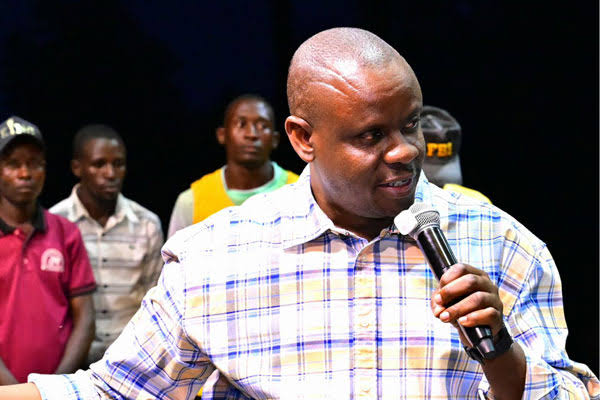
Officially Hon Balaam’s mission is part of the broad program , licenced by the NRM government under a directive of President Yoweri Museveni to rid Uganda of corruption or at least to stop it from haemorrhaging scarce public resources. Thus far Balaam and his fellow cabinet colleague, the serpentine, voluble and volatile Hon Justine Nameere MP (State Minister for Local Government) have moved through Bugisu, Greater Masaka and Ankole, turning inspections into public barazas at which citizens bring complaints directly to the ministers.
In Namisindwa, Balaam ordered the arrest of an assistant town clerk over an alleged Shs 28 million discrepancy in a land purchase. In Mbale, the tour chanced on allegations ranging from ghost workers and inflated school enrolment to a Shs73 million public toilet reportedly built without a functioning pit beneath it. A shit show really (no pun intended) whose stink is drifting steadily around the country sending many local government officials quaking, with the ones with bigger stomachs and waistlines ,wondering when a Bolshevik style denunciation will land them in a police station.
The remit is broad.
In Mitooma, officials have been interdicted while investigations proceed into complaints involving health, education, engineering and administration. By August 10, at least 26 local government officials across Isingiro, Buhweju, Mitooma and Mbarara City were facing interdiction or investigation after the Ankole leg of the campaign. This is important because Ankole is the President’s homeland and Balaam was making a point that no one is untouchable perhaps. West Nile is coming up.
Balaam’s roadshow has departed from the usual inspection meetings of government often carried out in officialese and dry correspondences. In the past these inspections have been the meal ticket for central government potentates to shake the corruption tree and pickup winnings in between budget audits. Not for Balaam. His eminence has flipped this script. His meetings have the boisterousness, theatre, immediacy and voltage of a political campaign.
In some dramatic social media videos, NRM yellow colours are seen everywhere but so too are flags and t-shirts with the image of MK. Balaam of course is not a typical NRM politician. Despite being a minister in an NRM government. His political home is the Patriotic League of Uganda or PLU, led by General Muhoozi Kainerugaba, the Chief of Defence Forces. He refers to the General as MK or Dear Leader or Supreme Leader depending on the occasion. He is also a very gifted grassroots communicator perhaps one of the most “on message” practitioners of the times. The Minister is famous for his orange t-shirt which appeared for a while like the only clothes he had save for their intended effect that he was identifiable everywhere he went.
Now he turns his Winnie the Pooh charm on in more standard dress fare of a minister in business casual plaid shirts, microphone in hand, but towed closely behind by police officers and military escort. While PLU says it is not a political party and claims that it did not field candidates against the NRM in the 2026 election, politically, however, it has built a national structure, appointed cadres and developed its own language of patriotism, discipline and accountability . Neither has the organization made it a secret that they believe Gen Muhoozi represents Uganda’s next political generation. Balaam himself is a senior PLU figure and PLU has publicly backed his anti-corruption drive.
The kinetic energy of this tour is therefore interesting on several counts and one can see where I am going with this.
Firstly, it is addressing the central promise of the post-election period ( Kisanja No sleep is about government efficiency and the fight against corruption) which has emerged as the most visible government attempt to right the wrongs of the last decades in this term of office. Corruption is rightly blamed for the poor state of social services and the political and moral corrosion of the NRM’s mission even if others say it is the reason that the NRM has managed to keep the country and the peace. Balaam’s tour which has the hallmarks of a political campaign on this very key aspect of the political contradiction of the ruling party stands out. Corruption is a form of government, would argue his colleague and fellow influencer Andrew Mwenda ( he has a book on the subject)
Secondly and thirdly (because they are related), Balaam is relitigating the just concluded election. The general election offered voters a chance to punish elected officials. These polls traditionally have a heavy attrition rate for incumbents. However, voters are also disempowered by the flood of money and violence that disfigure the final outcome. The difference with Balaam’s second election is that at his rallies voters get a “new chance”to punish not just elected officials but their “partners in crime”, the local cabal of administrators charged with implementing government programs such as agricultural credit, road works, bridges and so forth. The implication of this is that voters can return to a political process where their grievances are aired in public forum , not a secret ballot, and hold officials directly accountable. It has gravitas but it remains to be seen how deep this process will cut. Certain government offices charged with oversight are likely to be directly affected especially the Resident District Commissioners (RDCs) who are charged with monitoring government programs at the district and are the state authority (not government) on these matters. Then there is the question of disgraced local leaders who are bleeding political capital and perhaps waiting in the wings ( in the next general election) shall be members of Balaam’s PLU ( maybe).
This last point is relevant politically. Local government structures hibernate NRM’s political power between elections and often provide the talent that goes into politics at the LC level ( up to LC5). In short, they are the foundation of NRM’s political power. Now that they are being challenged and pressured by the PLU in this way, what does it mean? They are after all the foundational base of a system of accommodation, patronage and compromise that has helped the NRM keep together an extraordinarily broad political coalition and, with it, the country and the peace.
Lastly whom shall the grateful grassroots supporters credit, the NRM or PLU? or is this what the political alliance between the two will look like?
Until next time