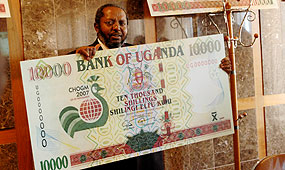
Ugandan currency market catches cold after Mutebile story

Its difficult to say immediately what long term impact if any the Central Bank governor’s comments will have. In Uganda’s sensitive market , whose confidence has been shaken by inflation figures and political risk concerns following the riots of the last few months, Mutebile’s comments, discussed earlier, are hitting a mark.

A Reuters story here suggests so. The head of marketing tracking at Barclays quoted in it adds that ” huge dollar demand in the interbank market and by the oil sector and with sagging supplies [has placed] the shilling is under enormous pressure”.

Looking ahead however full recovery, in my view, is unlikely to return until probably the 1st quarter of 2012. Other factors however seem on the upswing, food prices are stabilising and global oil prices too will be less worrying. However continuing political unrest, lack of confidence in public institutions, will continue to trouble the Ugandan economy.

In a low key event today Opposition leader Kiiza Besigye and his supporters clashed once again with the security forces. If support for these protests persists it will lend more un-certainty and stretch the recovery period for the shilling. One additional caveat is that Ugandan politics can surprise and beyond the opposition confidence-undermining events are possible but since we are not clairvoyant we can not say what they are.

For example ex-Vice President Gilbert Bukenya’s impending trial on corruption continues to generate interest. See an interesting post here by Chris Obore- the head of investigations at the Daily Monitor. It suggests that the VP ( a tactic he has succeeded with several times in the past) may drag other members of Cabinet into the fray or hope that the system saves him.

Uganda’s main banker speaks out on running the economy in hard times

Emmanuel Tumusiime-Mutebile, the bohemian free-market loving economist who has been the Governor of Uganda’s Central Bank since 2001 has signaled in an interview with the UK’s Financial Times, that the politics of his friend and boss the President is sinking the economy.

For the record the Ugandan shilling has been in record lows against the dollar and inflation at its worst in recent memory. The full interview has not been published yet but Mutebile, who is reported in Ugandan tabloids as the whisky loving, Mercedes Benz happy, frequent flyer- says some interesting things.

For one he refers to President Yoweri Museveni as hanging on to some “elements of marxisim“- and if i understand it [ am channeling myself here] that he is letting the government ( Uganda’s bloated public sector is evidence) and not the market carry the economy.

Mutebile opposes unbridled public spending and has said so in the past. Its understandable. Uganda’s macroeconomic fundamentals are essentially held together by smart monetary policy. The Central Bank has long been the last line of defence here- issuing Treasury Bills and other instruments to “mop up” excess liquidity and keep the shilling afloat.

This becomes difficult with elections- which over the last three cycles have also brought along with it new realities of an expanding ( and still expanding) public sector. Today’s economic problems which has seen street riots, record inflation and such are the CB’s biggest test yet. Its unnerving for Mutebile and it shows.

Gazing through his office window which overlooks Kampala’s vibrant downtown- he searches for clues of the future- and while he cannot predict complicated global currents that have shaken the global free market- he knows he can rest assured that the Ugandan government as far as he is a part of it will behave in predictable ways.


The FT article focusses Mutebile’s disapointment on a few items. One of them is the draw down of the national reserves to purchase jets, and the other is the feckless fuel economy- where Uganda remains unsecured without known, predictable national fuel stocks.

All the problems that he raises are really not new but here are some pointers worth the talk show circuit.

Firstly, that Mutebile is essentially powerless against the system that he criticises. If he opposed the purchase of jets, long asked for the government to reign in spending etc, he is powerless to stop it. This is not really new either but nonetheless, Central Bank independence is an important conversation to have ( his career may be in flux) as with any institution that is counterweight to the overarching influence of the Executive branch in Uganda.

Secondly, his reference to marxism is interesting. I have long told friends that even if Uganda’s formal government/and politics has a progressive, democratic, free market face; its internal organs, the informal government (of which Mutebile straddles both) belies a different breed. This endoskeleton or second government is essentially a throw back to the NRM’s revolutionary past and its recent history of transformation.

And because of the political career of Mr. Museveni it is modeled closely on his interests or what he calls his “vision”.

Indeed. Universal Primary and Secondary education, access to health and the NRM’s vast political superstructure have remained unchanged aspects of its intention to bring change in fundamentally marxist/socialist terms. Of course these donor funded programs can also be interpreted as progressive policies that are recognisable as World Bank/IMF funded “reforms” and not vehicles for some concealed socialist agenda.

But the facts are there to be interpreted.

In any event- the large government ( and Uganda’s other characteristics like its rapid urbanisation, its young and mobile population) cannot co-exist as a hybrid and we learn from Mutebile how these contradictions are playing out today and could seed the unraveling of this marriage of pragmatic socialism- in a world policed by the free market- with Uganda’s undoubtedly modern democratic institutions.

The other issue is how oil wealth will play into all of this. Ostensibly it should not matter much how socialist programs are pursued if one can afford it. The President has indicated that social spending as well as spending on infrastructure will continue.

But in Mutebile’s world view perhaps the future of Uganda as Venezeula in Africa is not as attractive as one of Uganda as a mini United Kingdom.

But hey. We don’t all get always get what we signed up for. This is a developing story.

Follow

Get every new post delivered to your Inbox.

Join 7,453 other followers

%d bloggers like this: